York County · Pennsylvania
Attic-Routed Radon Pipe Installation in York, PA
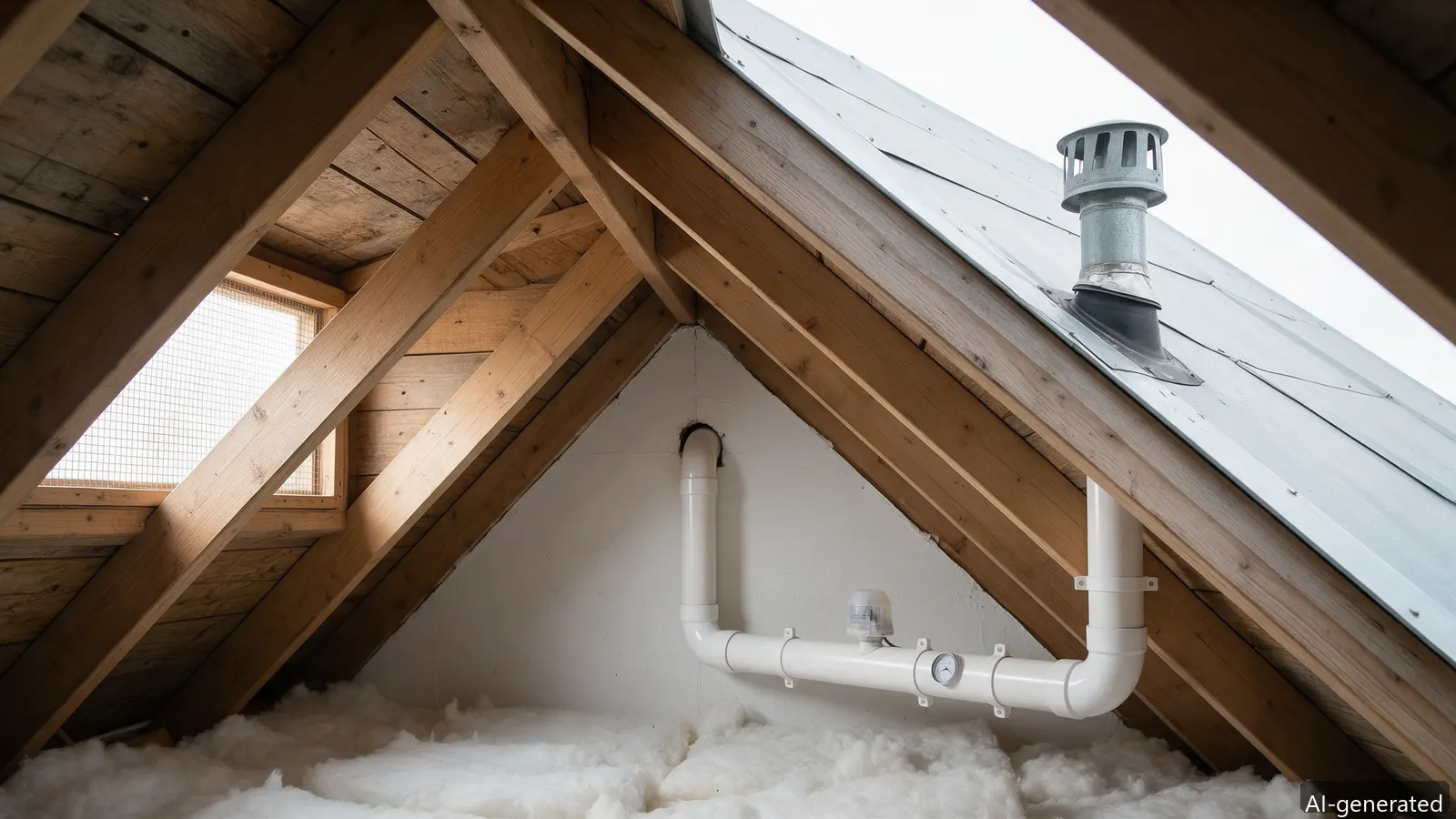
PA DEP’s guidance is unambiguous about aesthetics: interior pipe runs through a closet or garage with the fan in the attic are the preferred configuration — quiet, protected from weather, and nearly invisible from the street. Exterior runs are the fallback when no interior path exists.
Attic routing costs slightly more in pipe and labor but preserves siding and resale appeal — the reason most York County quotes offer it as the default option.
The attic configuration changes the physics of the house you live in: pipe runs inside conditioned space stay warm, which keeps condensate liquid until it drains back to the suction point — no freezing bursts in January, no water stains tracking down a bedroom wall. The fan lives in unconditioned attic air where its hum cannot reach a finished basement ceiling, and any future service happens without touching siding. Exterior runs remain the honest fallback — painted to match, mounted low on a rear elevation — but PA DEP’s preference for interior pipe with attic fans exists because the failure modes mostly disappear.
The pipe rises with a continuous positive slope — a level run anywhere en route re-wets the system’s low point forever. Penetrations at each floor plate get sealed, not just drilled. The fan mounts on band hangers clear of joists, with the DEP-required label and the installer’s certification number visible at the gauge, and the manometer hangs where the manometer gets read — eye level near the unit, not buried in insulation. Discharge clears the roofline with its cap oriented away from prevailing wind-driven rain. Each item is checkable at walkthrough in under five minutes, and the post-installation test at 24-plus hours closes the file.
York County buyers’ agents increasingly photograph the radon system during showings. An interior run with an attic fan photographs like plumbing; an exterior run photographs like an afterthought — same performance, different impression, and impression moves negotiation. For the seller with an existing exterior system, the upgrade conversation is real: converting routing at service time costs a fraction of the goodwill it preserves, and the retest paperwork ties the file closed either way.
PA DEP prefers interior pipe with attic-mounted fans: protected, quiet, invisible. Exterior runs are the fallback — both must discharge above the roofline.
Modestly — more pipe and care through the home; it preserves siding and curb appeal, which real-estate deals notice.
A standard single-point system installs in 3–5 hours. Crawl-space membranes, two-point systems or complex pipe routes run a full day. The post-mitigation test starts at least 24 hours after the fan turns on.
Interior runs through a closet or garage with an attic fan disappear almost completely. Exterior runs up a back wall are painted to match. Fan placement rules (distance from windows, discharge height) constrain the options; a good installer walks you through them before drilling.
No. A soil-depressurization system treats airborne radon. If well water carries radon (common in Pennsylvania bedrock wells), that needs an aeration or granular-activated-carbon treatment system — see the well-water page.